

5
min read
The Wait Is Over: It’s Time for a Better Pre-visit Experience
Written by
Published on
March 7, 2022
Share


Subscribe to our newsletter
Stay in the loop in our resources and insights
Thanks for your message!
We will reach back to you as soon as possible.
Over the last two decades, we’ve seen user-obsessed tech giants change nearly every consumer industry. Fast, simple and flawless digital experiences are now expected when we’re working, consuming media, buying products or interacting with friends. Encountering anything less is disappointing.
However, healthcare hasn’t caught up. Partially due to minimal competition, healthcare providers and payers haven’t had as much incentive to innovate as companies in other industries.
That healthcare still lags far behind other sectors is critical because healthcare has one of the largest brick-and-mortar consumer footprints of any industry. While the Wal-Marts, Targets and other big retailers have markedly increased digital capabilities and omnichannel experiences, health systems have a lot to lose by keeping their status quo.
Today, though, things are changing at breakneck speed due to factors like the pandemic and the No Surprises Act. Consumers are demanding more value for their dollar, which has created unprecedented demand for digital health options. Telehealth investment is increasing exponentially, reaching an all-time high of $57.2 billion in 2021, close to double the 2020 spend. Disruption is underway, and the future will not be kind to those who don’t adjust to modern consumer demands.
While telehealth holds promise, a recent J.D. Power study found that patient satisfaction with digital services has declined, and most people still prefer in-person care.
So how can we fix this huge problem?
Why patients have trust issues
Much of the healthcare journey today is meant to serve the administrative needs of healthcare organizations rather than the patients. This is particularly true of the pre-care journey. Pre-visit touch points can help develop trust and set clear expectations for the rest of the patient journey, yet they tend to be cold and bureaucratic.
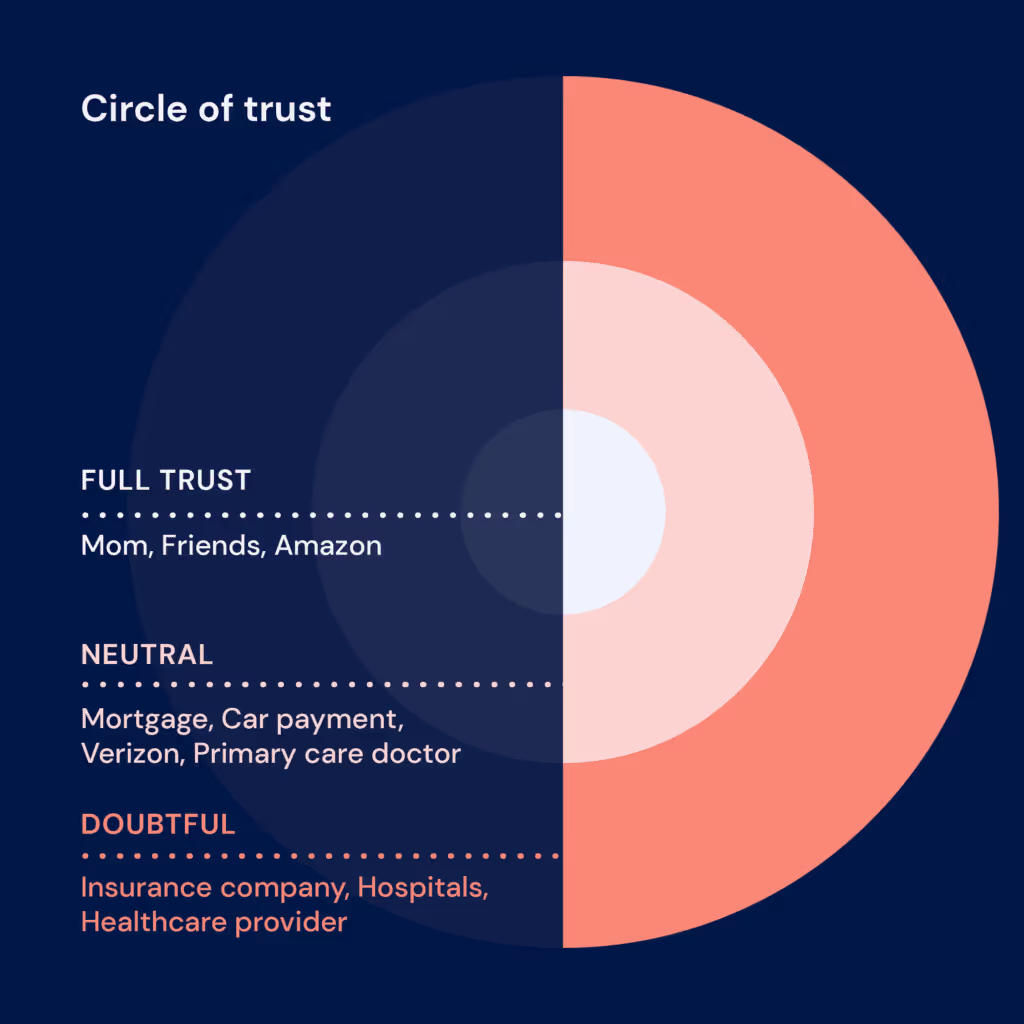
A few years ago, we conducted an exercise with the consulting firm IDEO where we asked people to rank how much they trust different entities in their lives and put them in a “circle of trust” (see below). The center encompassed the most trusted entities and the concentric rings contained progressively less trusted entities moving outward.
You’ll note respondents claimed to trust Amazon almost as much as their mom, the reasons for which we’ll come back to. Primary care doctors fall near the middle ring, as are mortgages, interestingly. Here people feel like the entity is collaborative and helpful, but in more of a professional capacity.
The outer circle, representing doubt, is occupied by entities that people feel do not have their interests at heart. In this space, respondents highlighted relationships that felt competitive, antagonistic or even hostile. Look where providers, hospitals and insurance companies live.
This is a huge problem.
In fact, I would argue this is the biggest problem payers and providers face.
It’s why many don’t pay medical bills. It’s why many don't necessarily take their doctor's advice, go to referrals or even show up for appointments.
And the main reason for this distrust is the aforementioned financial and administrative experience. Typical pre-visit experiences just brusquely tell you to show up and pay money or reschedule. The vast majority of human interactions are cold, and any algorithmic component is one-size-fits-all with unreliable estimates (if a patient is lucky enough to get that).
As a result, this old system does not foster good expectations.
Cedar Pre and consumer-centric healthcare
What if there was a better way—a more intuitive, convenient and compassionate way for patients to navigate the healthcare journey up to the point of care?
Imagine a knowledgeable and caring friend or advocate helping you. What would they do and say? They’d probably share everything they know with you and be transparent about any costs or responsibilities. If you had questions, they’d proactively answer them, comfort you on the appointment day and message you in an empathetic tone. Even though they might not be able to chat 24/7, they’d make time for you and genuinely try to help.
We believe providers and payers can achieve that level of trust.
To help them get there, we’re incredibly excited to launch Cedar Pre, a digital pre-visit solution that offers patients a full concierge experience before care starts. We view Cedar Pre akin to a digital “friend” or advocate that helps patients anticipate all steps, eliminating all guesswork, searching and confusion.

Cedar Pre facilitates financial coordination, care preparation and administrative intake. For example, patients will have clear visibility into expected costs for all planned services–including out-of-network care–with easy access to resources that can jumpstart eligible financial assistance options like Medicaid.
Patients can now have personalized experiences customized to their wants and needs, while preserving their agency, similar to what wealth managers do for clients. Built to anticipate individual needs, Cedar Pre delivers the right information at the right moments prior to service so patients can take needed action and avoid surprises.
Coming back to Amazon, the reason they’re at the center of the circle of trust? They have a deep and quantifiable understanding of what makes users tick, developed through the investment of enormous resources. And they structure every interaction around user needs, constantly testing, experimenting and changing their offering to increase engagement over time.
There are pre-visit solutions on the market that technically “check the box” when it comes to features (appointment reminders, intake forms, payment capabilities etc.). But a disparate feature list will not get providers to Amazon status, because it won’t really improve results. Additionally, existing solutions don’t integrate with payers or other third parties with whom patients may have to interact prior to care.
We believe Cedar Pre is the next horizon in consumer-centric healthcare. It will bring massive benefit to all; providers can anticipate higher paymentss and fewer no-shows, and payers can eliminate administrative friction. Most importantly, patients will have a significantly improved sense of confidence and clarity in the care they are about to receive, elevating the entire healthcare experience.
We couldn’t be more inspired to help drive this new era, and we hope you join us in this exciting and important new step in the evolution of care.
Arel Lidow is Cedar's Technical Co-founder and Distinguished Product Architect.
See related blog posts
See how Cedar connects the dots

with an empathetic, easy-to-understand billing experience.

cost-to-collect
with self-service solutions and fewer vendors to manage.

satisfaction
with transparent billing and flexible payment options.

with agile, streamlined tools that mirror the patient’s view.