

Insights
5
min read
Improve Patient Engagement With These 3 Data-Driven Best Practices
From a consumer point of view, the healthcare industry leaves a lot to be desired. On top of worrying about care, patients often have to navigate anti...
Written by
Claire Bevan
Published on
April 7, 2022
Share


Subscribe to our newsletter
Stay in the loop in our resources and insights
Thanks for your message!
We will reach back to you as soon as possible.
From a consumer point of view, the healthcare industry leaves a lot to be desired. On top of worrying about care, patients often have to navigate antiquated systems that don’t measure up to modern expectations, which erodes trust and sets the stage for contentious interactions.
But all is not lost. Forward-thinking healthcare leaders can take three steps to regain trust and create a better patient experience.
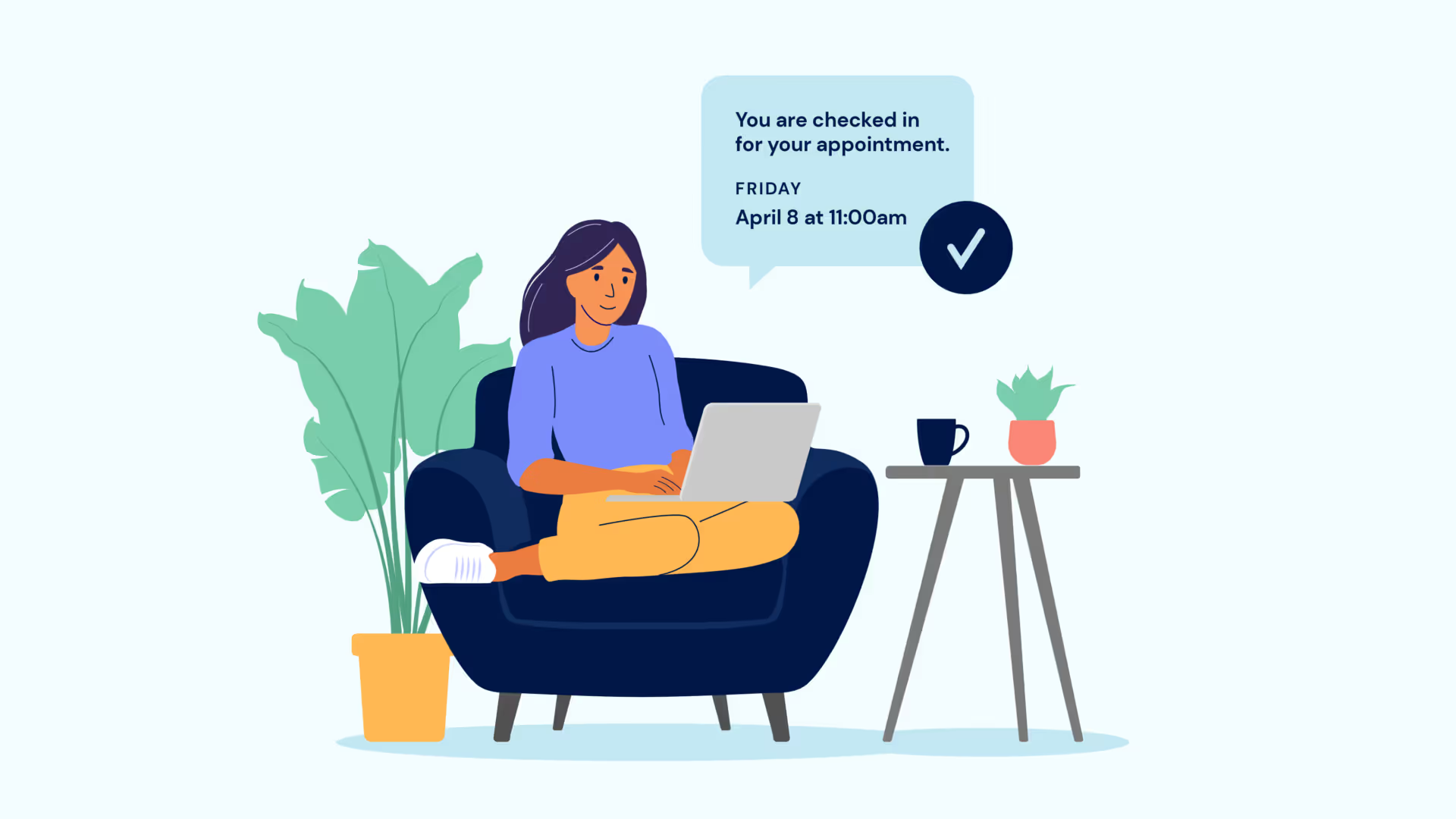
1. Remove barriers with simplified check-in
What do airline travel, food pickup, and amusement park rides have in common? Fast, simple and flawless check-in that minimizes or completely eliminates wait times and paperwork. Why not healthcare? We found that 23% of patients wish they had the option to check in using a virtual waiting room, similar to the status quo with so many other digital consumer experiences.
There’s no reason providers can’t streamline financial coordination, care preparation and administrative intake by delivering the right information at the right time prior to the point of care. An easy check-in helps patients take more action and providers see better results.
2. Offer prepayment options
The fact is many consumers are more than happy to resolve bills right away. According to Cedar’s Healthcare Consumer Experience study, 79% of patients are willing to pay out-of-pocket costs prior to or at the point of care. Additionally, more than half say they wish they were able to pay a guaranteed out-of-pocket price prior to receiving care, or at the point of service.
With the continuing need for providers to comply with the No Surprises Act, it’s mutually beneficial to offer clear and transparent pricing so patients can either pay in full or set up a payment plan that maximizes the likelihood of bill resolution.
3. Use empathetic language
Empathetic messaging might appear counterposed to an effective payments strategy. But user data shows language and tone matters. A friendly approach leads to better financial outcomes.
In data science experiments, we found that making copy more compassionate can increase payments 3% for certain patient subgroups. Hundreds of thousands of dollars just by changing a couple words!
A friendly approach leads to better financial outcomes.
Along with increased payments, these kinds of communications can elevate operational efficiency while lowering administrative costs. At the same time, they can give patients peace of mind, build trust and improve satisfaction overall. A considerate and consumer-centric approach to billing strengthens relationships while generating more revenue; kindness goes a long way.
Putting it all together
There’s no question healthcare has a lot of systemic issues, especially around costs. Some of these issues are complex and nuanced, requiring alignment of larger legislative, institutional and market forces. But many barriers to patient engagement don’t fall into those categories. The patient journey is full of opportunities for quick wins that providers (and payers) can take advantage of to boost engagement, particularly during the pre-visit stages.
By pulling these three easy levers, providers can make inroads in deepening patient loyalty and markedly improving the end-to-end patient experience.
See related blog posts


Built for patients. Powered by intelligence. Proven in performance.
Product visuals and descriptions may be in development and are subject to change. Certain functionalities may require third-party integrations or service-specific terms or fees. Patients served, patient interactions, and payments processes represent Cedar cumulative metrics since 2017. Cedar Support, Cedar Kora, and Cedar Cover metrics reference data from pilots in 2024 and 2025. Cedar Pay metrics reference data from 2023 to 2026, including weighted averages. All performance metrics, as well as testimonials from Cedar clients, are provided solely for illustrative purposes, and are not a guarantee of future results.
