

Cedar Updates
5
min read
Cedarians in (Zoom) Cafes Getting Coffee: Trey Brademan, Integration Support Lead
Cedar employees may still be working remotely, but that doesn’t stop us from connecting over coffee (or bubble tea!) and dreaming of the days when our...
Written by
Claire Bevan
Published on
July 15, 2020
Share


Subscribe to our newsletter
Stay in the loop in our resources and insights
Thanks for your message!
We will reach back to you as soon as possible.
Cedar employees may still be working remotely, but that doesn’t stop us from connecting over coffee (or bubble tea!) and dreaming of the days when our cat isn’t the only living soul we see in the flesh (though now we can all spend less time searching for funny cat memes, amiright?). Today’s featured Cedarian is Trey Brademan, our talented integration support lead whose team helps to ensure that Cedar’s clients have the technical support they need after implementing the Cedar platform.
Hi Trey! We’re enjoying a coffee chat on Zoom, ‘cuz, you know, NYC is still not fully open and most of us are still working remote. That being said, when you do go out again with colleagues for an in-person coffee chat, where’s your first stop?
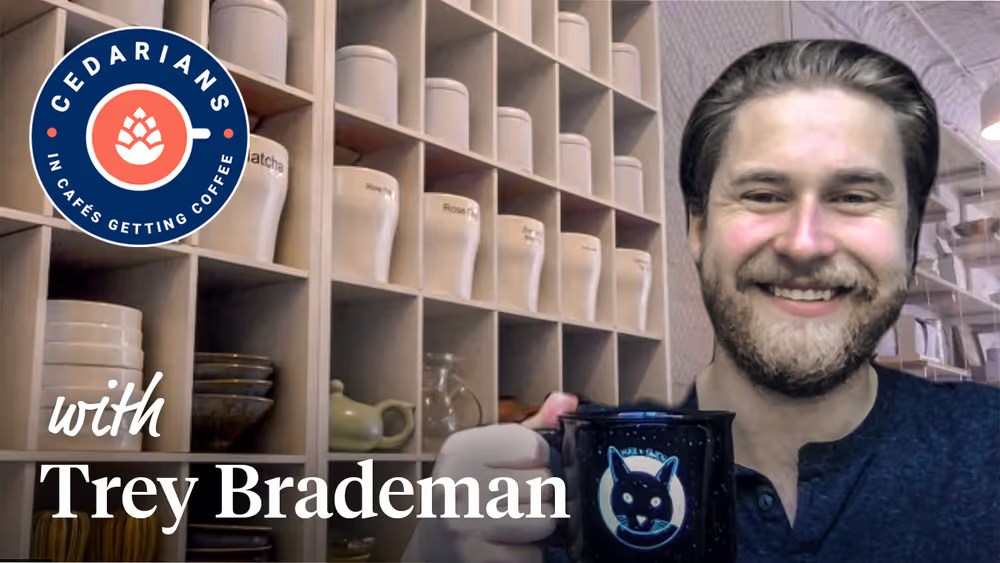
As you may be able to guess from my Zoom background, I’m wishing I was at Luv Tea, on Bedford Street near Cedar’s West Village office. I initially went months ago to try their bubble tea but then discovered that they have an amazing zen garden. I started going there quite often to hang out, but now that we are quarantined, I try to have a “zen Thursday” coffee chat with other Cedarians via Zoom. Not the same, of course, but still good to connect with friends.
So…your beard…that’s new. I love it and I can’t look away.
Yeah, I grew it when we all had to shelter in place. I was planning to shave it, but it’s such a good conversation starter in all my remote meetings, I can’t seem to part with it. I’ve never looked more like my lumberjack roots.
I’m all for something to distract me from recent headlines and your facial hair is a great place to start. Beyond that, how about your life story—can you tell our readers what you did before Cedar?
I grew up in a small town called Esko with about 1800 people. I stayed in Minnesota for undergrad and studied mathematics, but moved to Wisconsin when I was hired to work on the integration team at Epic Systems. That was my first real exposure to the healthcare space. My first six months at Epic were spent learning how the US healthcare system worked and how to write code in MUMPS (yep, that’s a thing). I then worked to implement and support data pipelines at hospital systems like NYC Health + Hospitals and University of Rochester Medical Center.
After a couple of years at Epic, my girlfriend and I decided to take the “long-distance” out of our relationship and I moved to New York City to join a health information exchange (HIE), Healthix. Although I was hired as a Project Manager, over time I shifted into a Data Analyst role. I taught myself SQL on the job, and found a passion for interpreting data and writing programs to communicate my findings.
As I gained more experience as a software engineer, I began to feel a desire to be a part of a growing company. One day (just over two years ago) I received a text from a former Epic colleague, introducing me to Cedar.
What drew you to Cedar?
I wanted to stay in healthcare but I had never considered patient billing until I interviewed at Cedar. Not only did the mission resonate with me—providing the most seamless financial experience possible for patients—but there was also a huge emphasis on small teams, 1:1 mentorship and a culture-driven environment (plus the free lunch with unlimited snacks didn’t hurt!).
The team at Cedar had incredibly large aspirations, which, given how hard change can be in healthcare, seemed near impossible. However, after seeing how smart and passionate the employees were, I was confident Cedar would achieve their goals, and more. The moment I walked in for my interview, I felt at home. Yes, part of it was the cozy Soho office, but I also saw that Cedar had brought in the best and the brightest, and meant to keep it that way. It was truly a place I would be able to stretch my fledgling engineering wings and fly.
What a cool story! So, tell us what you do at Cedar now.
The Integration Support team keeps our data pipelines open and bug-free. As the Team Lead, it’s my responsibility to ensure that the team is able to triage and resolve reported technical issues effectively, provide our amazing Product Success team with the tools necessary to gauge priority and urgency for said issues, and transition integrations from the Implementation team (the ones building these pipelines from scratch) so they can focus on the next client in our pipeline.
I like to think that we’re the ones responsible for the first “R” in ARR (Annual Recurring Revenue). Without us here to keep the product working smoothly and providing a feedback loop, our revenue would be much less likely to “recur.”
I was actually the first dedicated Support person (technical or otherwise) at Cedar and have had the pleasure of watching our Product Success team grow from monitoring a Gmail inbox to answering hundreds of tickets per week. Our technical team has gone from fixing individual issues, to resolving root causes for complex bugs, and working with our Implementations team to ensure future integrations don’t make the same missteps as their predecessors did.
Cedar’s technical product integrations are extremely important to our success as an organization and our skill in this area is something that really has set Cedar apart from competitors. Can you tell us a little bit about that and why you think Cedar’s approach works so well?
In my experience, healthcare is a very slow moving industry. Enterprise EHR implementations literally take years, and leaders in the industry can be incredibly risk-averse. This is why, when I first started with Cedar, I actually laughed out loud when I heard that our implementations are measured in weeks, not months. However, people at Cedar are smart, driven and willing to take calculated risks in order to advance and improve our product. Our Implementations team is full of top-notch engineers that swiftly identify gaps in understanding and edge cases in workflows that, if left untouched, could mean significant losses in revenue for the healthcare provider.
Additionally, as Cedar expands, our previous learnings become outdated. As such, our team holds weekly design sessions and regular touchbases to bring new use cases to light and quickly receive feedback on their proposed ways to handle effectively.
Our integrations are as living as the product itself. Our Support teams actively work with the Implementation and larger Engineering organization to help scope and triage new client requests, and communicate lessons learned from older integrations. This feedback loop, along with our exposure to the greater Cedar codebase, puts us in a unique position to inform and shape new products and integrations from a technical perspective.
What’s been your favorite part of your Cedar experience? Any favorite memories you can share?
The people here are what make the Cedar experience so special. One thing that was genuinely new to me was a Slack feature we use that automatically matches you up with another Cedar employee for coffee, at random. I’m always excited when a new pairing comes out (which is incredible for a self-proclaimed hermit like myself), and each coffee chat exposes me to a unique perspective I would not have encountered otherwise.
I have many favorite memories, including the completion of my first project, multiple years of a true Oktoberfest (German co-founder, anyone?), and amazing company-wide retreats. However, the moment I always use to describe the culture at Cedar actually happened before I was hired. The day after my in-person interview, my hiring manager called to say they hadn’t made a decision yet, but if I was interested, Cedar was hosting an employee game night, and I was more than welcome to join. I sat there panicking for a few minutes. (What does this mean? Is this good news? Is this a final, hidden test?) But it was in fact a genuine invitation just to join and have a good time. No subtext. To me, that’s really what Cedar is all about. Yes, this is a job. Yes, there are high expectations. But it’s also a group of people excited to make connections with others and improve people’s lives in whatever way they can.
Cedar just announced a Series C round of funding and is growing quickly. Can you talk about the growth and what Cedar is doing well to make this an exciting place to work?
I started when Cedar was approximately 30 people and now we have over 125. It’s been an incredible experience seeing so many new faces shape the company for the better. I think Cedar is doing a fantastic job of encouraging us all to get to know each other on a personal level, especially during this pandemic.
Prior to quarantine, there were happy hours, holiday parties, karaoke nights, game nights and so much more. But despite the health crisis and remote work, we have kept this culture of “togetherness” alive. During COVID, there still have been happy hours, game nights, book clubs, a Zoom watercooler, a crossword puzzle channel, and I’m even hearing whispers of a virtual karaoke night. We dedicate a significant amount of time to maintaining the culture that’s been so successful for us, and this is what helps us work so well together.
I hate to wrap this up, Trey! Your excitement about Cedar is contagious. But, let’s go out on a high note—what’s something that we may not know about you that might surprise our readers?
First, I adore cats. I have two beautiful boys, and now that we’re in the days of Zoom meetings, I will fully check out of conversations if a coworker or friend has a cat in their background.
Second, I’ve run out of room in my apartment for more plants. It’s impossible for me to give them away or leave them for dead, and our home is slowly turning into a greenhouse.
Lastly (super nerdy) but I’m a dungeon master! It not only gives me a chance to be creative and have fun, but it’s also a great way to bring my friends together every few weeks.

Trey Brademan is an integration support lead at Cedar. And, as you’ve just read, he loves cats, plants, D&D, and growing impressive amounts of facial hair.
Interested in becoming a Cedarian? Check out our current openings.
See related blog posts


Built for patients. Powered by intelligence. Proven in performance.
Product visuals and descriptions may be in development and are subject to change. Certain functionalities may require third-party integrations or service-specific terms or fees. Patients served, patient interactions, and payments processes represent Cedar cumulative metrics since 2017. Cedar Support, Cedar Kora, and Cedar Cover metrics reference data from pilots in 2024 and 2025. Cedar Pay metrics reference data from 2023 to 2026, including weighted averages. All performance metrics, as well as testimonials from Cedar clients, are provided solely for illustrative purposes, and are not a guarantee of future results.
